top of page


miz-oo-mo
Mizumo

At-A-Glance
Biome:
Capital City:
Region:
Category
Population:
Flora:
Fauna:
Societal Structure:
Red Hex Status:
Rocky, Forest, Misty
Kazador
Middle-East Anarkand
C
54M
Highly Diverse
Slightly Diverse
Civic Co-operation
Active. 100% efficiency
L a n d s c a p e


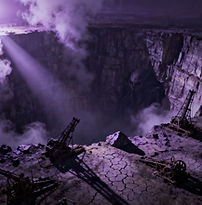
Takaros Mountain Range
Tora Matra
Twelfth Valley
Illumina Entrada


A b o u t
Mizumo lies just north-east of the protected lands of Sagozia, where the geography itself seems undecided on whether life should exist at all. Before history learned its name, Mizumo was a scoured expanse of mineral flats, black stone ridges, and wind that carried nothing but dust. What life exists now does so because the land was rewritten.
That rewriting came in the form of the Lumin.
Mishakari legend speaks with near unanimity on one point: before the Lumin, Mizumo was dead. No forests, no rivers, no sky worth remembering. The first Mishakari were wanderers on the edge of extinction, guided not by maps but by recurring visions shared across bloodlines. These visions drew them inward, toward the most desolate point of the land.
There, beneath fractured stone and ancient pressure, they found the Hidden Spring.
When it was disturbed, the land exhaled.
The Lumin rose not as vapour, but as presence. A bioluminescent mist that did not merely illuminate but responded. It wrapped around the Mishakari, slowed their aging, sharpened their perception, and stabilized their fragile biology. Where the mist touched soil, life followed.
To the Mishakari, the Lumin was a gift from their gods, not metaphorically but biologically. Their physiology entwined with it over generations. Without the mist, Mishakari bodies begin to unravel. Aging accelerates. Cellular cohesion fails. Death arrives early and without ceremony.
But the land had already been claimed.
The Kaleena, native to Mizumo long before the spring was uncovered, emerged from the surrounding wastelands. Their bodies were denser, more resilient, adapted to extremes. They could survive without the Lumin longer than the Mishakari, but exposure to it enhanced them. Strength increased. Lifespans extended. Wounds closed faster.
To the Kaleena, the Lumin was not divine. It was resource.
Two truths occupied the same mist, and neither could coexist.
The Battle of the Lumin Springs
The first and bloodiest collision came swiftly.
The Mishakari, led by Chieftain Kaalik, fortified the Hidden Spring and the surrounding basins. Shrines were raised. The mist thickened, responding to ritual and presence. The Mishakari believed faith would be enough.
The Kaleena arrived with war.
Under Warlord Drayk, they advanced without reverence, cutting through mist barriers and shrines alike. For days, Mizumo burned with bioluminescent fog lit by fire and blood. Weapons struck bodies already half sustained by Lumin, causing deaths that glowed long after life left them.
The Mishakari lost.
Kaalik fell. The springs were seized. The mist did not abandon the Kaleena, and that single fact shattered Mishakari theology forever.
What followed was not peace, but exhaustion.
The Mishakari withdrew into the deepest mist-fields, places where the Lumin pooled so thickly that even Kaleena physiology strained to endure it. Hidden enclaves were formed, not cities but living structures shaped by mist flow. Defensive lattices, sensory veils, and reactive traps turned the fog itself into a weapon.
The Kaleena entrenched themselves around the springs, building fortresses that drank the Lumin in controlled cycles. Their warriors grew larger, older, more brutal. Lifespans stretched unnaturally long, breeding a ruling caste that remembered every slight.
Raids replaced battles. Ambush replaced siege. Children on both sides grew up knowing the sound of the mist when it thickens in anger. The Illuminatra were not soldiers at first. They were preservers, archivists of mist behaviour, children trained to listen to the Lumin rather than command it. Over generations, listening became mastery.
Their greatest figure was LuMaelis, a warrior-priestess whose presence altered the Lumin’s behavior simply by standing within it. Under her leadership, the Mishakari stopped retreating.
They began reclaiming.
THE GREAT SIEGE OF ILLUMINA CITADEL
The Illumina Citadel sat atop the largest known Lumin reservoir, a Kaleena stronghold believed unassailable. Its walls were engineered to vent mist outward while starving attackers. Every previous assault had failed.
LuMaelis attacked the mist itself. Under a deliberately overfed night cycle, the Illuminatra destabilized the Citadel’s mist channels. Fog thickened beyond control, swallowing sight, sound, and orientation. Kaleena defenders aged rapidly as mist was drawn from them unevenly.
LuMaelis confronted Drayk at the heart of the reservoir. Their duel unfolded within a vortex of living light. Drayk fought with centuries of experience. LuMaelis fought with the land’s consent. When Drayk fell, the mist surged toward her and the Citadel was reclaimed. However, victory did not end the conflict. It transformed it.
The Mishakari now control the most vital Lumin reservoirs, but the Kaleena endure. They adapt. They remember. They raid from the margins, stealing mist where they can, experimenting with artificial containment, even attempting to synthesize crude imitations.
bottom of page