top of page


ter-ee-us
Tyrrius
At-A-Glance
Biome:
Capital City:
Region:
Category
Population:
Flora:
Fauna:
Societal Structure:
Red Hex Status:
Diverse lands
Laguna
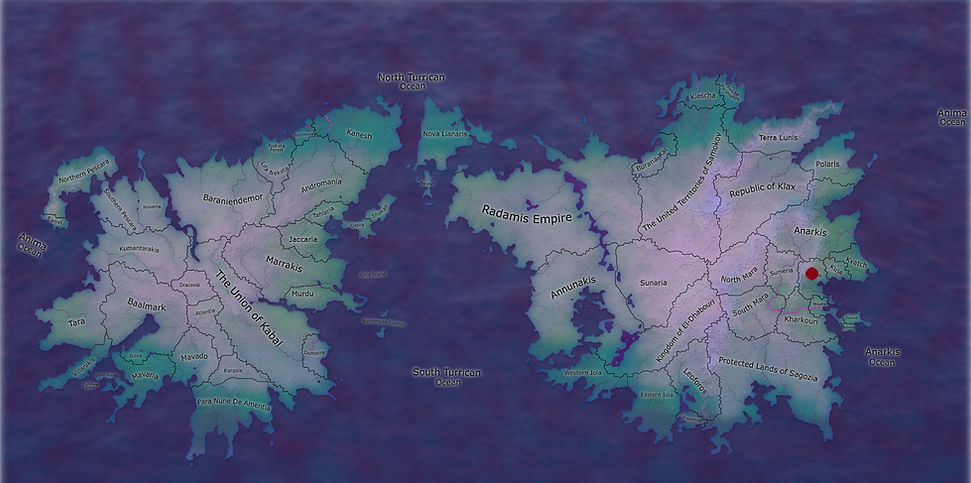
Middle-East Anarkand
C
5M
Highly Diverse
Highly Diverse
Hereditary
Active. 100% efficiency
L a n d s c a p e


The Verakore
The Planetarium
Dhandra
Laguna Palace



A b o u t
FOUNDATIONS OF FIRE
Tyrrius emerged during the consolidation struggles of the late 6th Era, when fractured territories in the central belt sought unity against shifting imperial pressures. Its early leaders cultivated a strong internal identity built on patriotism, cultural cohesion, and religious centrality.
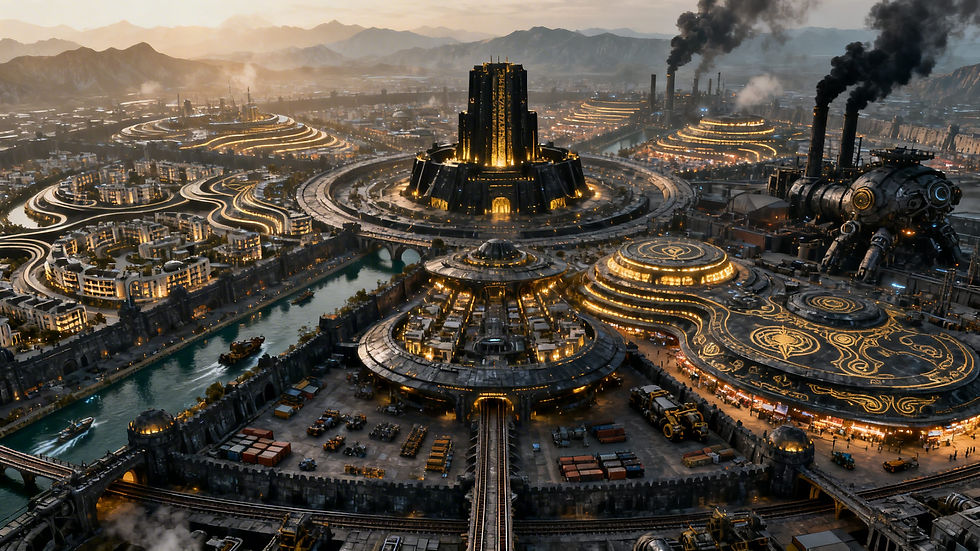
The nation coalesced around Laguna, its capital and most populated city. From the beginning, Laguna was less a seat of administration and more a symbol. Massive public squares, national processions, and architectural displays of unity defined its early development.
The Tyrrian doctrine formed around three pillars:
Faith.
Strength.
Continuity.
THE KONDELANIN DYNASTY
At the centre of Tyrrius stands the ruling family, the Kondelanin.
Their palace dominates Laguna’s elevated quarter, a sprawling complex of stone courtyards and gilded spires overlooking the city’s central axis. The Kondelanin trace their lineage to the first unifier of Tyrrius, claiming both political and spiritual mandate.
The family governs through a hybrid system: ceremonial monarchy intertwined with executive authority. Though councils exist, ultimate influence flows through the palace.
The Kondelanin adopted a strict religious doctrine centuries ago, embedding faith directly into state policy. This belief system emphasises preservation of cultural purity and warns against rapid transformation. Technological advancement is permitted only when it reinforces sovereignty or defence.
Modernisation, therefore, advances slowly.
LAGUNA
Its population is the largest in Tyrrius, and its citizens are known for fervent national pride. Murals depict Tyrrian victories and symbolic triumphs over past adversaries. National festivals draw immense crowds clad in crimson and gold. Laguna’s economy is administrative and strategic. Military headquarters, policy chambers, and cultural institutions cluster around the palace.
It is also where Tyrrius’ military doctrine is shaped: independent, defensive, but aligned in philosophy with Radamis’ emphasis on strength over diplomacy. Laguna sees the world as competitive and it intends not to be outpaced.
LARRYIUS
Larryius is famed across Anarkand for its singular achievement: a one of a kind planetarium unmatched in scale and projection fidelity.
Constructed during the 9th Era, the Larryius Planetarium was intended as both educational institution and theological reinforcement. Its dome projects immersive cosmic simulations intertwined with religious interpretation.
Larryius became a centre of controlled curiosity. Astronomy is encouraged, but always filtered through the state’s spiritual doctrine. Scientists in Larryius operate within boundaries established by religious authorities. It is a city that gazes upward, but carefully.
KAVOS
Kavos is Tyrrius’ industrial engine. Factories line its outskirts, producing machinery, processed metals, and military components. The population is dense, and labour culture is deeply intertwined with national pride. Unlike Laguna’s ceremonial grandeur, Kavos is practical. It builds the war machines, the transport fleets, the defensive hardware.
However, the same religious conservatism that governs Laguna limits Kavos’ technological ceiling. Advanced automation and cutting edge innovation are frequently delayed or rejected if perceived to threaten social stability. Industrial output is strong, but its evolution is somewhat constrained.
LOKATO
Lokato houses the largest religious structure in the world: the VeraKore. The VeraKore is not merely a building. It is an institution in stone. Vast halls, towering spires, and internal chambers capable of holding tens of thousands at once. Its scale is intended to overwhelm.
Religious authority radiates from Lokato. Senior clergy maintain close advisory ties to the Kondelanin family. Many state decisions are sanctified here before implementation. Pilgrimages to the VeraKore are considered essential for loyal citizens. It reinforces the doctrine that Tyrrius’ destiny is guided and protected, but only through unity and restraint.
DHANDRA
Named “the forgotten city” not officially, but by its own inhabitants. Despite Tyrrius’ wealth and industrial capacity, little of that prosperity filters into Dhandra. Infrastructure is aging. Employment opportunities are scarce. Public investment lags decades behind other cities. Dhandra’s people are loyal, but increasingly restless.
Many argue that if Tyrrius truly seeks modernization, it must begin here. Yet funding proposals are often stalled by political prioritization of military expansion or religious infrastructure.
THE STRUGGLE FOR MODERNISATION
Tyrrius claims determination to modernize. Policy speeches frequently invoke economic growth and technological relevance, but the religious framework adopted by the Kondelanin places strict limits on what form modernization may take. Rapid social change is viewed as destabilizing. Certain scientific avenues are restricted. Cultural preservation supersedes experimentation.
This tension defines modern Tyrrius.
The younger population, particularly in Kavos and Dhandra, increasingly calls for broader reforms. The Kondelanin respond cautiously, adjusting policy incrementally without surrendering doctrinal authority.
THE KONDELANINS
The Dynasty Behind the Velvet Curtain. For an entire Era, the Kondelanin family has ruled Tyrrius. Officially, they are described as guardians of faith; custodians of continuity and the chosen stewards of national destiny. History, however, tells a sharper story.
ORIGINS IN CRISIS
The Kondelanin did not begin as monarchs. They emerged during the political fragmentation that followed Tyrrius’ early consolidation struggles. The founding patriarch, Arven Kondelanin, positioned himself as a unifier during a period of economic instability and religious uncertainty. He aligned closely with the clergy of Lokato, promising protection of doctrine in exchange for political endorsement. It was a transaction disguised as destiny.
When Arven consolidated executive power, it was framed as temporary stabilization, but temporary lasted an Era...
THE ERA OF CONTROL
Over generations, the Kondelanin refined their grip.
They centralized wealth into palace controlled holdings. Key industries in Kavos were placed under “protective stewardship,” which in practice meant partial ownership by royal trusts. Trade tariffs were adjusted to ensure a steady stream of revenue into Laguna’s upper quarter.
While Tyrrius remained economically strong on paper, a disproportionate share of national wealth accumulated within palace vaults and affiliated religious institutions. This led to Dhandra’s poverty deepening whilst Laguna's palace got bigger. The family cultivated an image of austerity while quietly constructing private estates, offshore accounts, and exclusive investment councils shielded from public oversight.
RELIGION AS LEVERAGE
The Kondelanin’s most effective instrument was not the military. It was doctrine. By embedding themselves deeply within the authority structure of the VeraKore in Lokato, they framed political dissent as spiritual deviation. Calls for rapid modernization were described as threats to cultural purity. Reformists were not jailed en masse, but they were marginalised, discredited, reassigned.
Progress was slowed not by open prohibition, but by procedural suffocation. Technological initiatives that might decentralize power were delayed indefinitely. Educational curricula emphasised obedience and reverence for continuity. Independent economic actors found themselves entangled in licensing systems that quietly favoured palace aligned enterprises.
The result was elegant stagnation. Tyrrius did not collapse, it simply never accelerated.
THE WEALTH CONSOLIDATION
Over the past century, palace led holding companies expanded into aerospace contracts, mining exports, and defence procurement. Officially, these were national assets, unofficially, dividends flowed through layers of trusts controlled by the Kondelanin.
Infrastructure investment in Dhandra was repeatedly postponed due to “budgetary recalibration,” even as ceremonial renovations in Laguna continued uninterrupted. The wealth imbalance effectively became an open secret.
THE CURRENT GENERATION
The present head of the family, High Ongardian Malvek Kondelanin, maintains the public persona of solemn devotion. He speaks frequently of sacrifice and preservation. Critics however, note that under his leadership, modernization initiatives have slowed further. Restrictions on independent research have tightened and surveillance in urban centres has quietly expanded.
Malvek’s inner circle consists largely of family members occupying strategic posts in finance, defence oversight, and religious councils. Power rarely leaves the bloodline.
WHY THEY ENDURE
Despite resentment, the Kondelanin remain in control for several reasons:
They maintain a strong, loyal military presence in Laguna.
They retain religious legitimacy through VeraKore endorsement.
They allow enough economic productivity to prevent collapse.
They avoid overt brutality that might spark unified revolt.
Their governance style is not chaotic tyranny.
It is calculated containment.
THE COST TO TYRRIUS
The greatest consequence of Kondelanin rule is not oppression in the dramatic sense.
It is lost potential.
Larryius could lead astronomical research free from doctrinal constraint.
Kavos could modernize its industrial systems dramatically.
Dhandra could be revitalized with a fraction of the palace’s reserve capital.
Instead, Tyrrius advances cautiously, tethered to a dynasty more invested in control than evolution.
bottom of page